
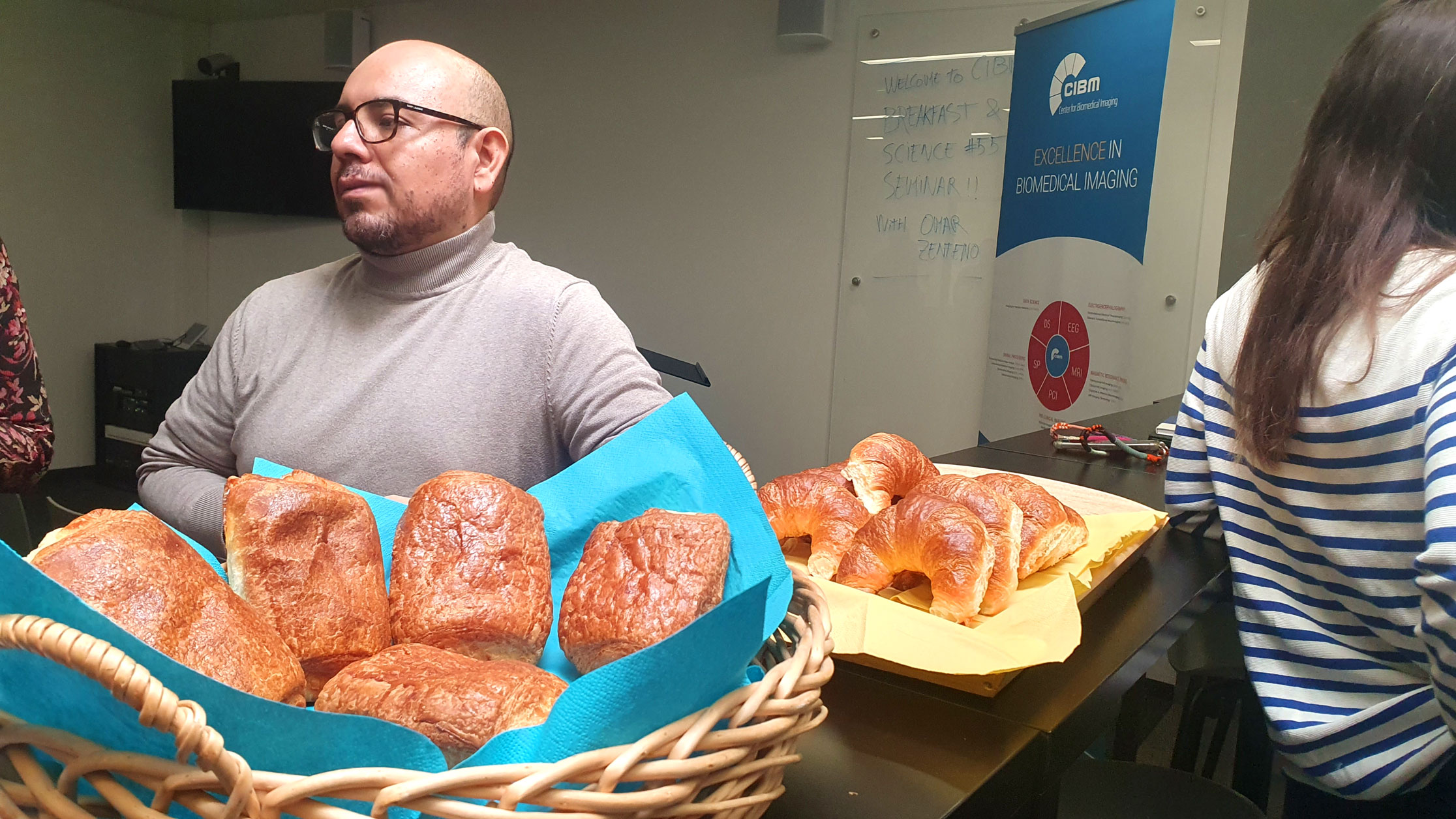
On February 24th, 2026, the 55th CIBM Breakfast & Science Seminar was presented by Omar Zenteno, Innosuisse postdoctoral researcher at the CIBM PCI EPFL Section. The event was chaired by Cristina Cudalbu, Head of the CIBM PCI EPFL Metabolic Imaging Section. The event took place at the CIBM seminar room at EPFL, Lausanne with an engaged audience of around 35 participants both online and on site.
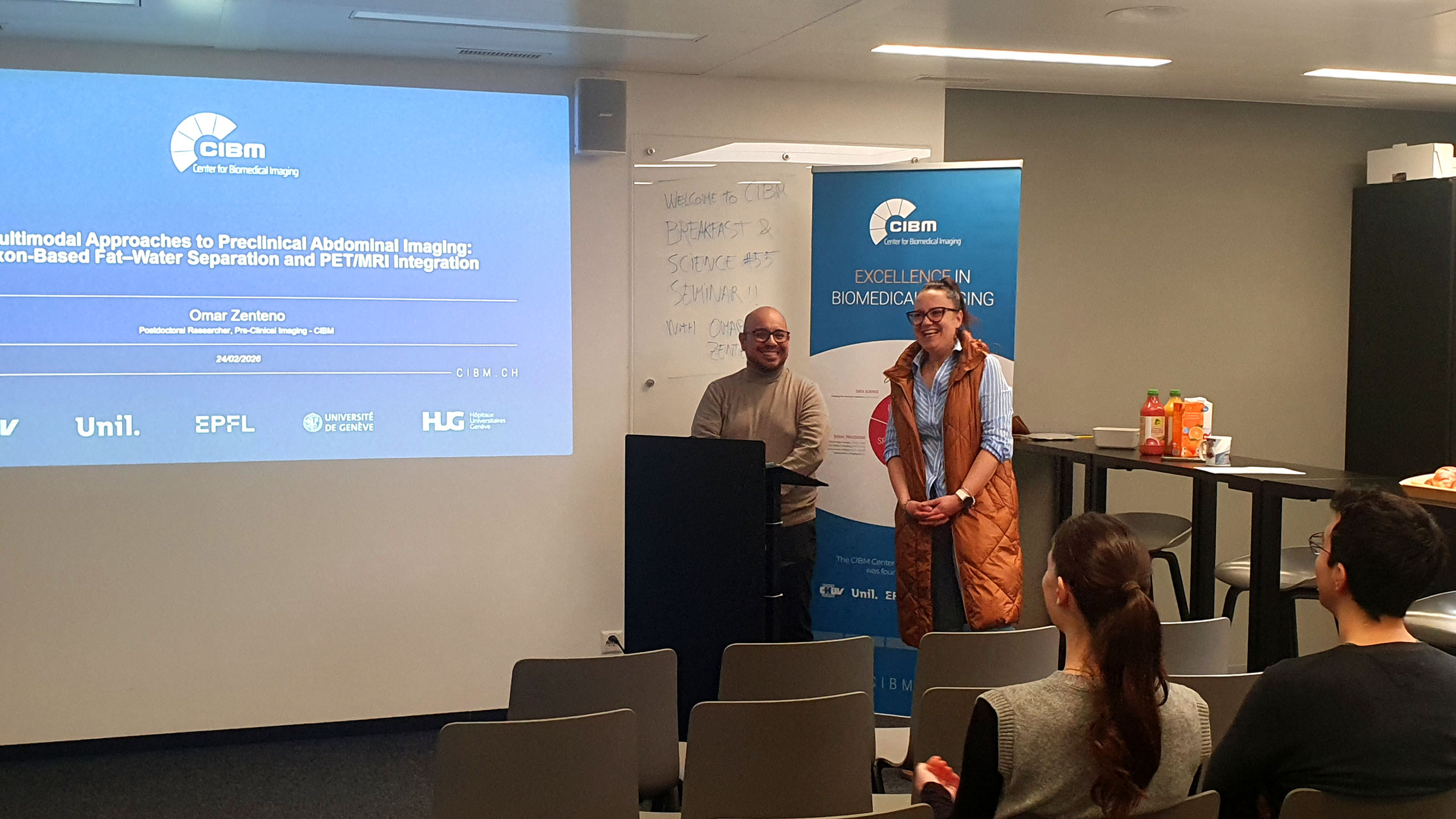
Multimodal Approaches to Preclinical Abdominal Imaging: PET/MRI Integration and Dixon-Based Fat–Water Separation
Abstract
Preclinical multimodal abdominal imaging enables longitudinal characterization of tissue composition and metabolic activity, but its quantitative exploitation requires robust integration of complementary contrasts. The recent implementation of a PET insert within the 9.4 T preclinical MRI system at the CIBM facilities provides a unified platform for combined metabolic and anatomical imaging.
Within this framework, Dixon MRI has been deployed for fat–water separation, enabling automated segmentation and quantitative longitudinal assessment of subcutaneous implants through changes in water content and fat infiltration. In parallel, the PET pipeline is being established to enable quantitative metabolic imaging, including the extraction of image-derived input functions and characterization of tracer dynamics.
Together, these developments establish the foundation for integrated PET/MRI analysis, with future applications toward combined assessment of implant evolution and multimodal correlation with spectroscopy MRI.
.

Omar Zenteno
About the speaker
Omar Zenteno, PhD, is a scientist specializing in multimodal medical image processing. His work focuses on developing techniques for image registration, segmentation, and quantitative analysis for both preclinical and clinical applications.
Dr. Zenteno earned his doctorate from the Université d’Orléans (France) through the ANR-EMMIE project, where he implemented registration and mosaicking techniques over white light and hyperspectral images, enabling the analysis of gastric mucosa abnormalities by identifying spectral patterns that reveal tissue composition and health. After completing his doctorate, Dr. Zenteno joined the Paris Cardiovascular Research Center (PARCC), where he led the translational phase of the PETRUS project, which integrated PET/CT and ultrasound for simultaneous metabolic and cardiovascular analysis, specifically applied to the study of carotid plaques. His work on this prototype resulted in a patent application and approval for the first human clinical trials.
Currently, Dr. Zenteno is at the CIBM Center for Biomedical Imaging at EPFL, supported by an Innosuisse grant with Volumina Medical under the supervision of Bernard Lanz. His work focuses on the design and instrumentation of multimodal MRI/PET sequences in animal imaging to monitor soft tissue reconstruction processes, with the goal of characterizing biomaterials for applications in regenerative medicine.
.