
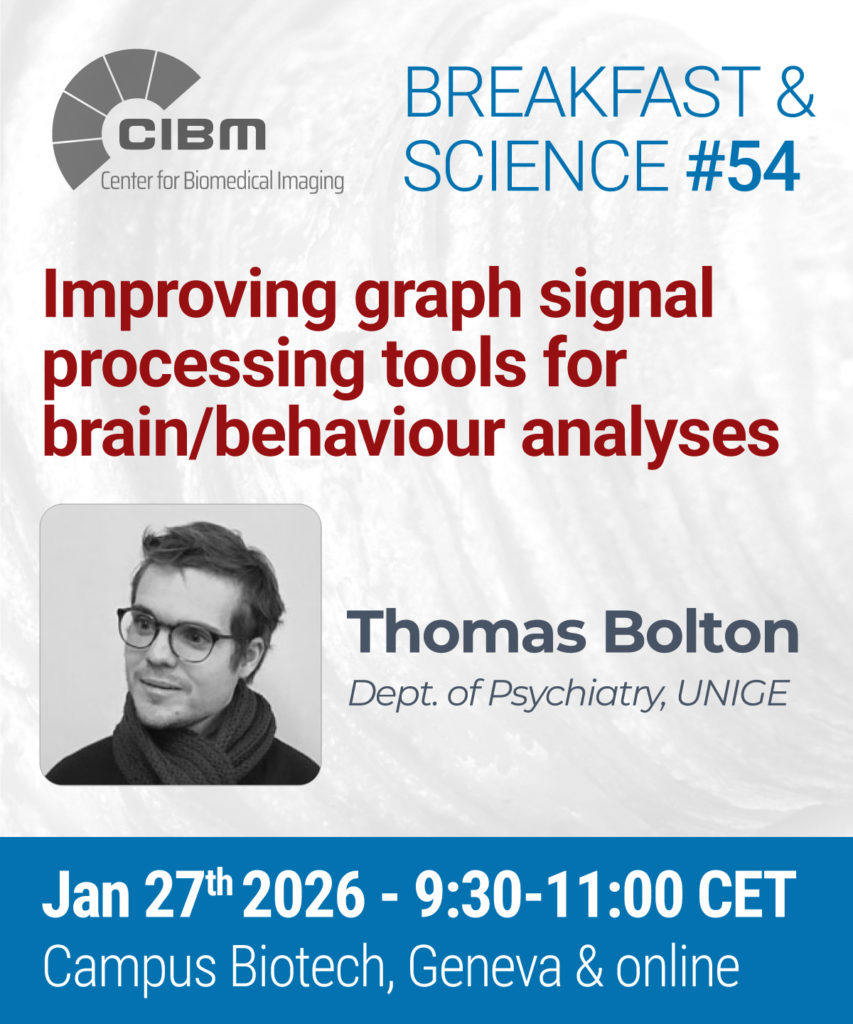
On January 27th, 2026, the 54th CIBM Breakfast & Science Seminar, the first session of the 2026 series, was presented by Thomas Bolton from the Department of Psychiatry at UNIGE. The event was chaired by Dimitri Van De Ville, Head of the CIBM SP EPFL-UNIGE Connectomic Imaging Section. It took place at Campus Biotech in Geneva with an engaged audience of around 30 participants.
Improving graph signal processing tools for brain/behaviour analyses
Abstract
Graph signal processing (GSP) in neuroimaging is the characterization of regional brain activity, measured with functional magnetic resonance imaging (fMRI), as a function of the underlying structure, inferred from diffusion MRI. In GSP, structural connectivity (the quantification of physical wiring between brain regions) is decomposed into a set of connectome harmonics, which are used as a basis over which to express functional signals. This enables to ascertain how much brain structure and function are coupled.
Previous studies utilizing this framework have successfully linked the extent of (de)coupling between brain structure and function to cognitive performance. However, they have also fallen short of outperforming the simpler use of functional connectivity (the statistical interdependence between brain activity time courses, computed without any structural information). In this presentation, I will start by recapitulating the fundamentals of GSP and overview its current applications in neuroimaging, with a focus on behavioural prediction. I will outline several limitations of current analytical workflows that suggest that current GSP approaches have not yet reached their full explanatory potential.
I will then propose ways to overcome these hurdles and test them in the context of behavioural prediction. First, I will touch upon the generation of connectome harmonics. I will show that working with a population-wise average induces biases in behavioural prediction pipelines, and that while more challenging, using subject-wise bases is a more appropriate strategy. Second, I will propose novel ways to extract metrics reflective of brain/structure function coupling, either by the use of more fitting parameters in current approaches, or by the application of a conceptually new framework.

Thomas Bolton
About the speaker
Thomas A.W. Bolton completed his Master in Life Sciences and Technology (Neuroscience orientation) at the Swiss Federal Institute of Technology (EPFL) in Lausanne, Switzerland, in 2013. Given the unmatched quality of the local chocolate, he decided to also pursue his PhD in Switzerland, transitioning from hands-on animal research to neuroimaging. Under the supervision of Prof. Van De Ville in the Medical Image Processing Laboratory (EPFL and University of Geneva), he combined his neurophysiological and signal processing skills for the development and application of novel dynamic functional connectivity approaches, capping this journey with a PhD awarded in February 2020.
Since then, Thomas has worked as a post-doctoral researcher in the Lemanic area. He first worked at the Centre Hospitalier Universitaire Vaudois (CHUV) in the Department of Clinical Neurosciences from February 2021 to February 2022, where he applied structural covariance analysis and probabilistic modeling to better understand the specificities of patients suffering from essential tremor. He then transitioned to the Department of Radiology, where between February 2022 and February 2025, he contributed to the development of advanced graph signal processing tools for brain/behavior analyses, which also happens to be the topic of his presentation. Finally, he betrayed the Lausanne community to move to the University of Geneva. Since February 2025, he has been working in the Department of Psychiatry on the extraction of personalized markers of brain activity for cerebellar transcranial magnetic stimulation in schizophrenia.