
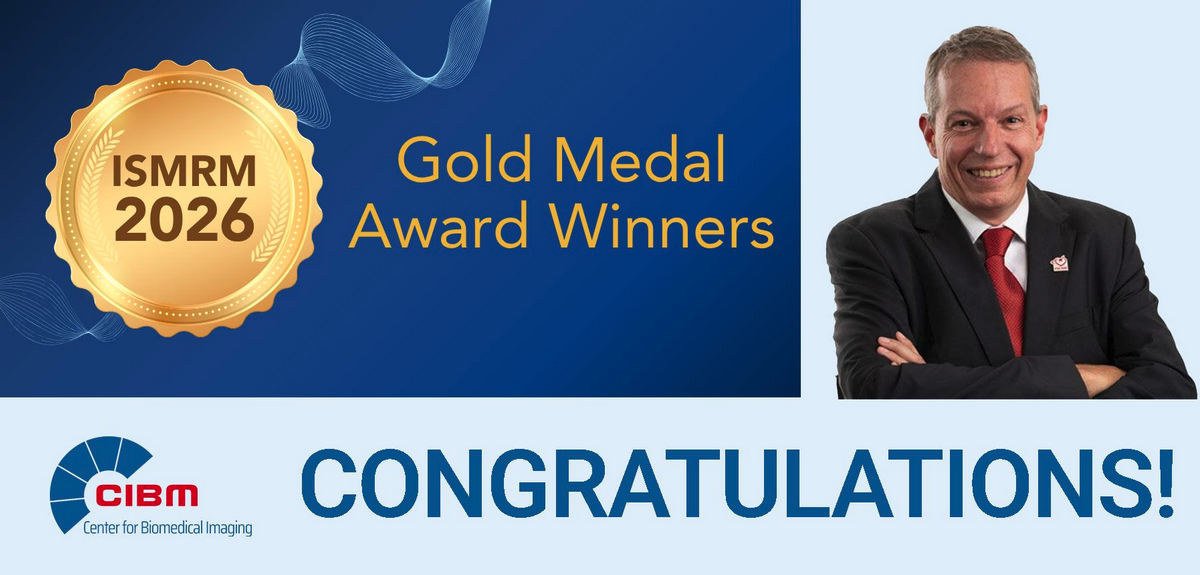
We are proud to announce that on May the 11th, Prof. Matthias Stuber, Head of the CIBM MRI CHUV-UNIL Section, has been awarded the prestigious ISMRM Gold Medal at the 2026 Annual Meeting of the International Society for Magnetic Resonance in Medicine (ISMRM) in Cape Town, South Africa. The ISMRM Gold Medal is the Society’s highest distinction and recognises individuals whose sustained scientific achievements have significantly advanced the field of magnetic resonance imaging.
As stated by the ISMRM, the award honours Prof. Stuber “for outstanding scientific contributions, sustained innovation in MRI technology, deep engagement with the ISMRM, and exceptional record of mentorship and collaboration.”
Over more than three decades, Prof. Stuber has established himself as one of the leading innovators in cardiovascular MRI. His pioneering contributions have advanced novel imaging methods that improve the visualisation and assessment of cardiovascular disease, helping to translate technical innovation into clinical impact.
Beyond his scientific achievements, Prof. Stuber has built interdisciplinary collaborations bringing together clinicians, physicists, engineers, and imaging scientists, while mentoring a generation of researchers who now hold leading positions in academia, healthcare, and industry.
This recognition also highlights the exceptional ecosystem developed at CIBM, CHUV, and the University of Lausanne. The close integration of research, engineering, and clinical practice has created an environment in which ambitious ideas can be translated into innovations with global impact. Over the past seventeen years, it has also enabled the emergence of an internationally recognised cardiovascular MRI program, further broadening the strengths and visibility of the Lémanic imaging community.
The award not only celebrates Prof. Stuber’s contributions to MRI, but also underscores the international standing of CIBM MRI CHUV-UNIL in cardiovascular magnetic resonance imaging and its continued commitment to advancing imaging science for the benefit of patients worldwide.