
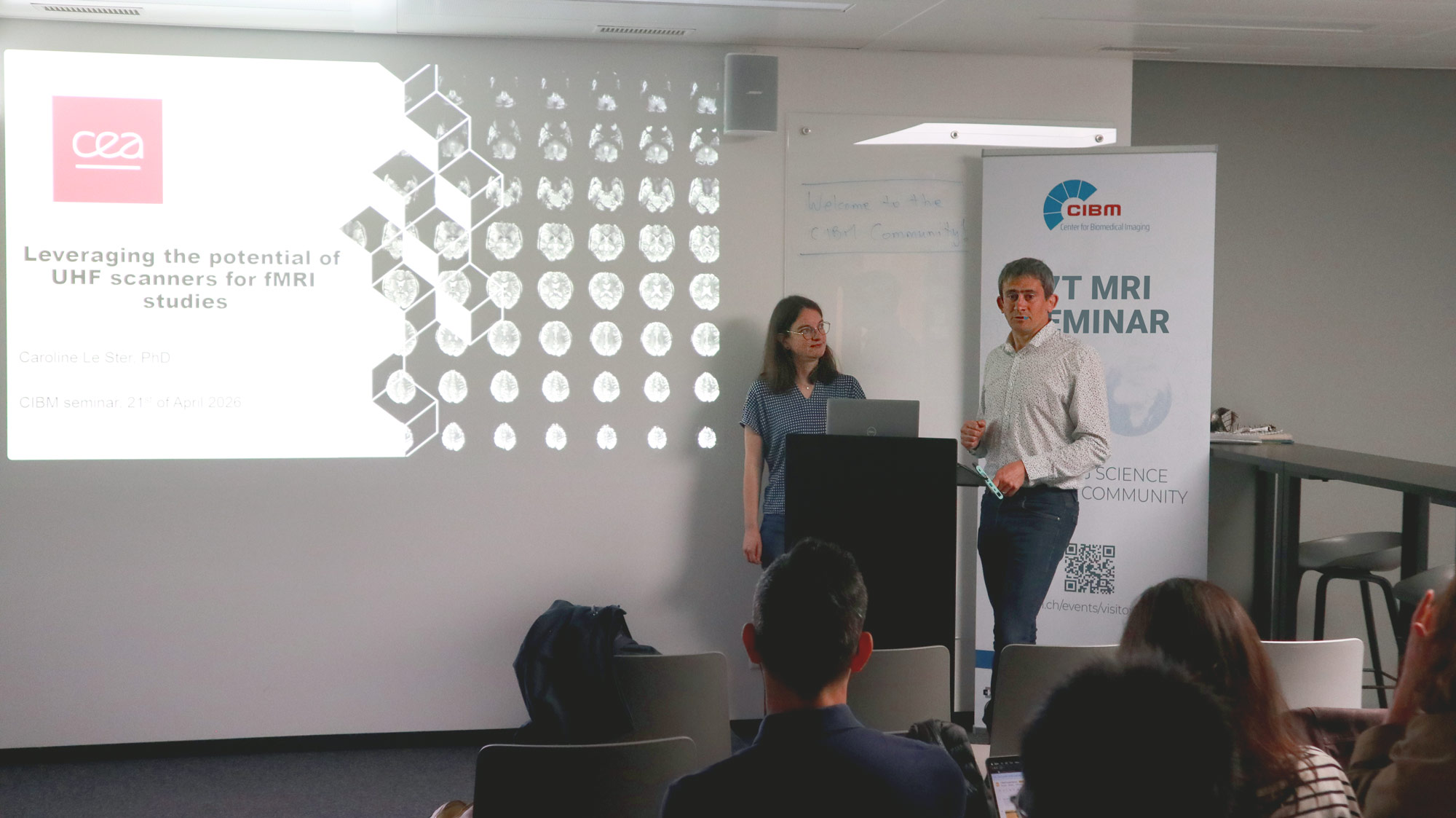
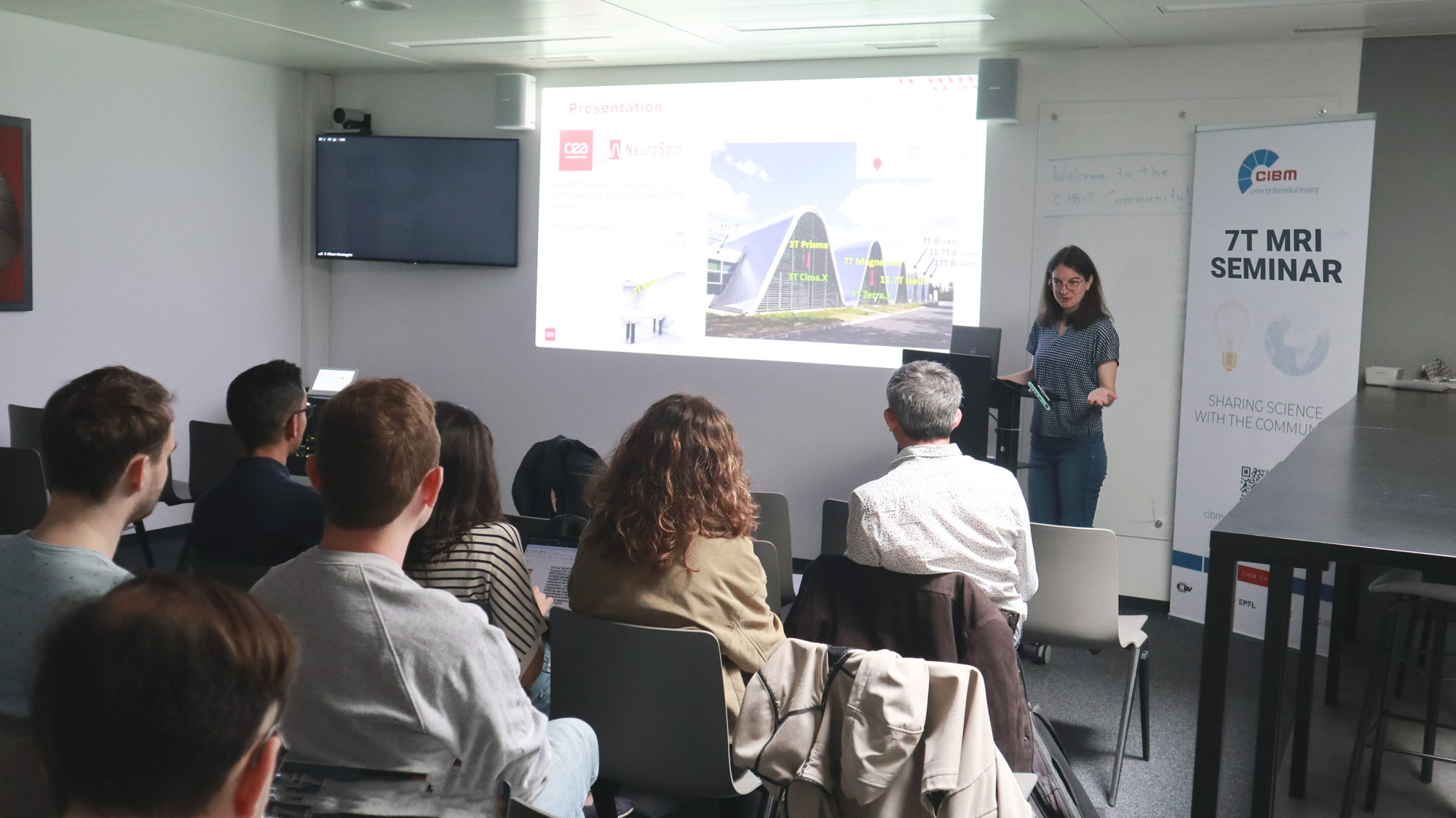
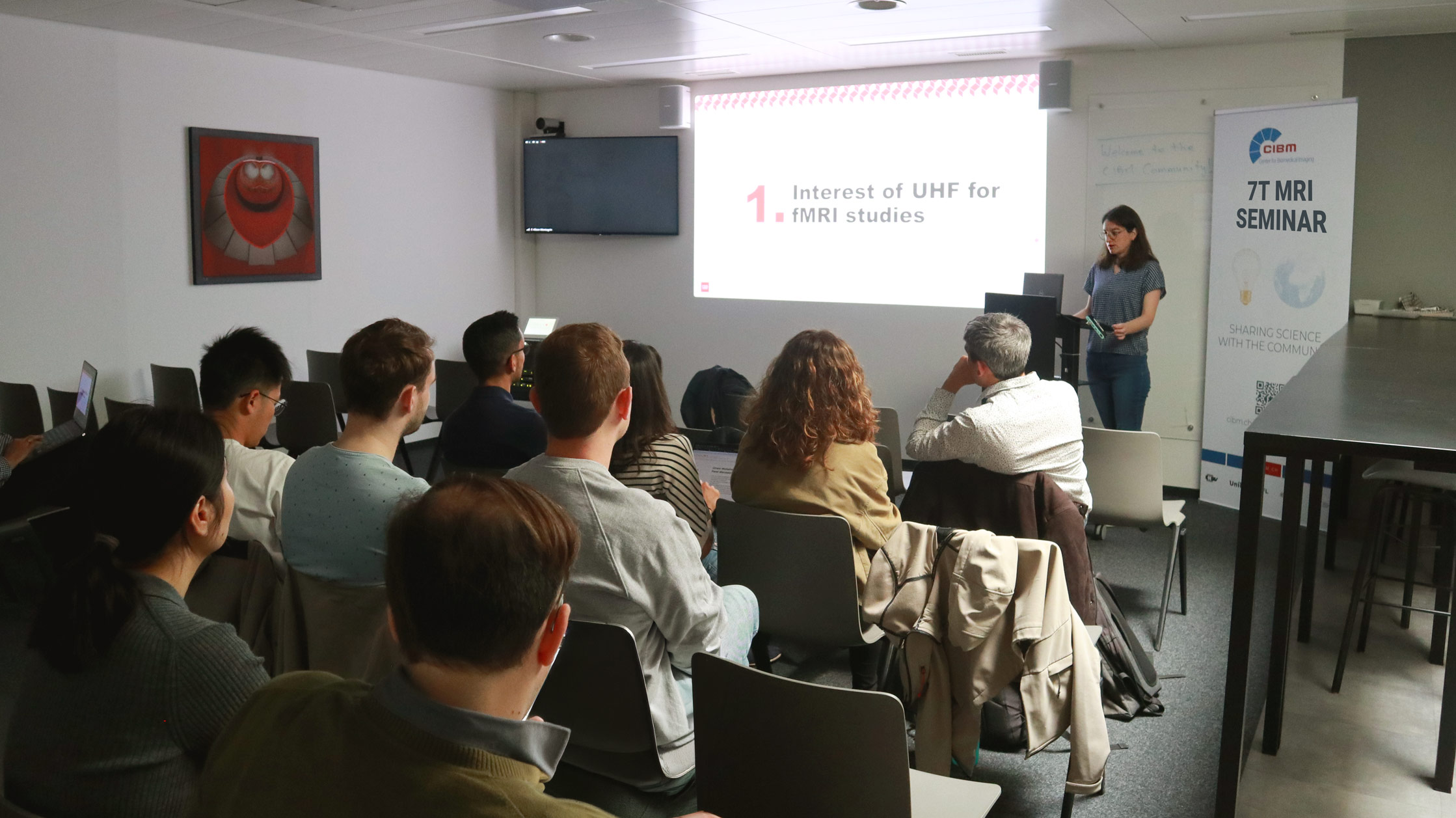
On April 21st 2026, Caroline Le Ster from the CEA Neurospin, Paris, presented “Leveraging the potential of UHF scanners for fMRI studies”. The session, hosted by Frédéric Grouiller, CIBM MRI HUG-UNIGE Section head, brought together around 30 researchers both online and in person at the CIBM seminar room in EPFL, Lausanne.
Insights
There is a growing availability of 7T scanners, with approximately 100 systems currently installed worldwide. These ultra-high-filed (UHF) scanners are particularly relevant for neuroimaging, where anatomical and functional images can be acquired with higher spatial and temporal resolution than on conventional scanners. However, UHF scanners remain difficult to operate, and understanding their specific limitations is essential. These systems indeed face several challenges arising from MR physics and biological effects that must be addressed within engineering constraints. Leverage the potential of UHF scanners, for instance through field monitoring, is therefore important to make the most of these scanners and benefit from the intrinsic SNR gain.
fMRI particularly benefits from the increase in magnetic field strength, enabling studies to be performed at higher resolution than at lower fields. In order to maintain reasonable acquisition times despite larger imaging matrices, several acceleration strategies have been developed, e.g. multi-slice EPI (SMS-EPI), three-dimensional EPI (3D-EPI) and non-Cartesian sampling schemes. In addition, functional contrasts also benefit from the field increase, including improved spatial localization of the BOLD contrast and the possibility to exploit VASO contrast.

Caroline Le Ster
CEA Neurospin, Paris, France