
On October 27th, 2026, the CIBM Breakfast & Science Seminar 61 was presented by Hamza Kebiri from CHUV-UNIL. The event was chaired by Marzia De Lucia CIBM EEG CHUV UNIL Section Head, . The event took place at the CIBM Seminar room at EPFL, Lausanne with an engaged audience of around 30 participants both online and on site.
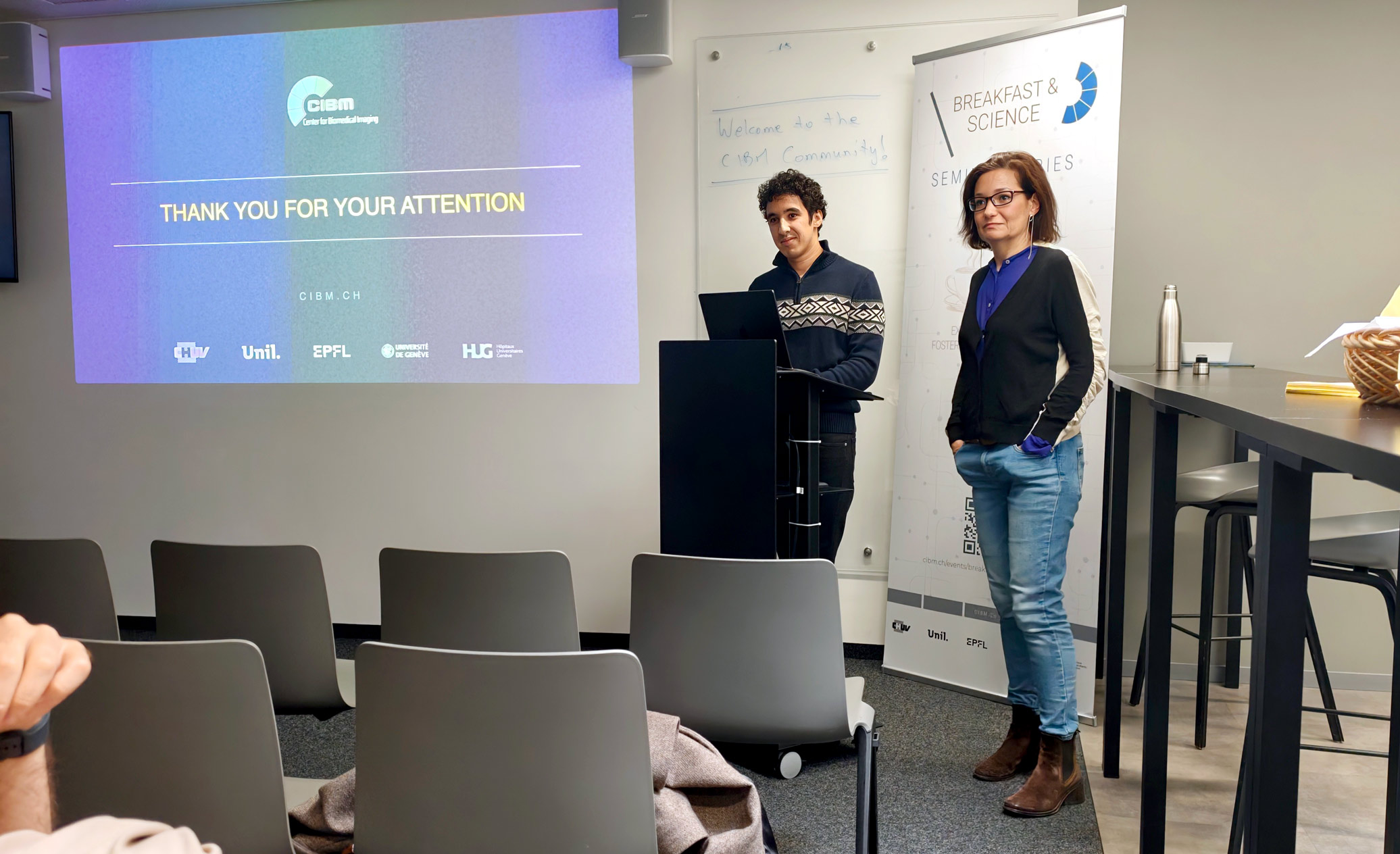
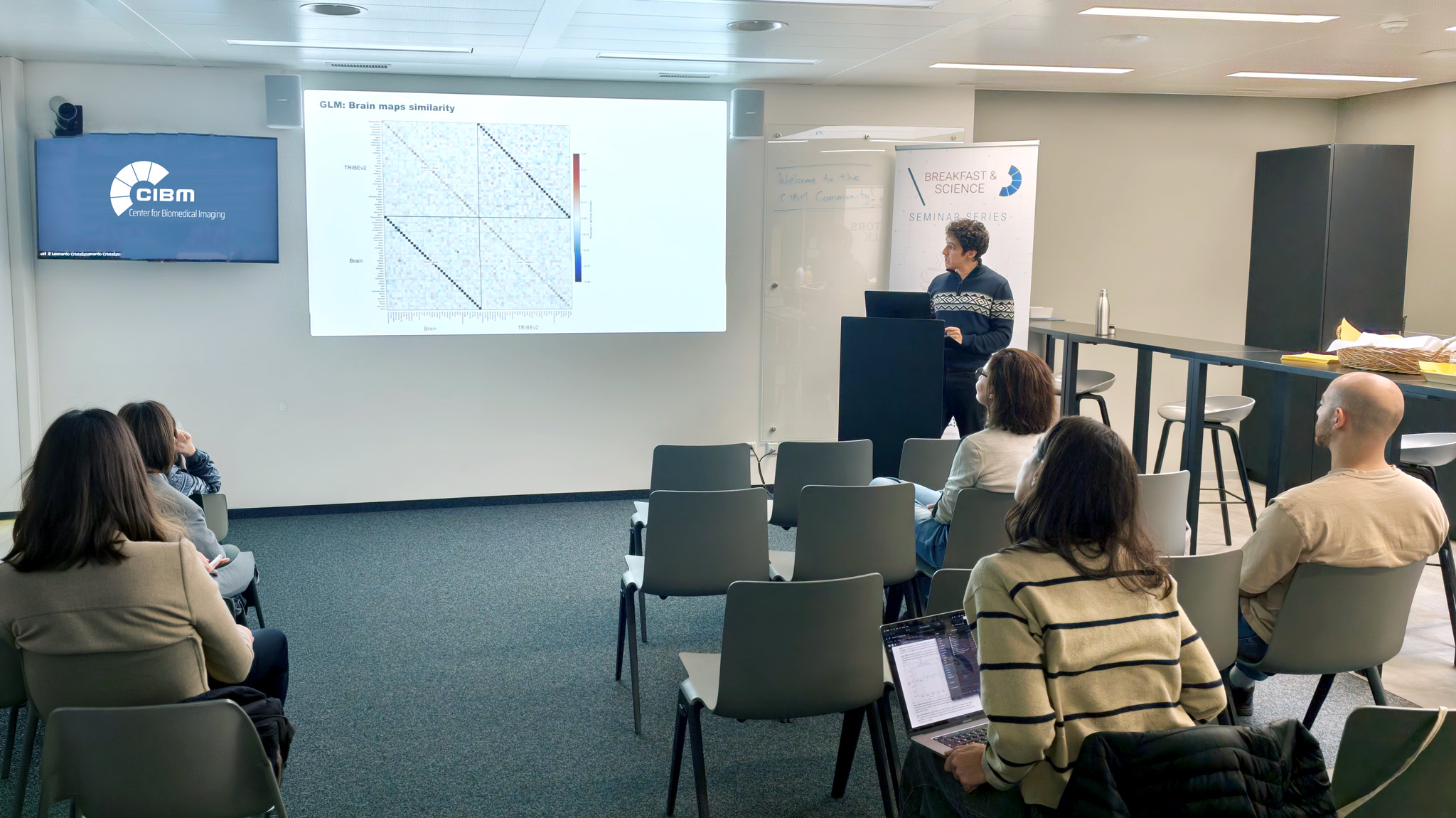
Do real and artificial brains encode emotions similarly ?
Abstract
Foundation models trained at internet scale have transformed artificial intelligence by learning general-purpose representations that can be adapted to many downstream tasks, including brain activity prediction. A growing question is whether these large-scale multimodal models can capture some aspects of the human brain.
In this preliminary work, we examine this question using TRIBEv2, a state-of-the-art multimodal brain encoding model designed to predict fMRI brain activity from naturalistic stimuli. Specifically, we ask whether TRIBEv2 captures emotion-related brain representations in a way that resembles empirical human fMRI responses. To test this, we use the EmoFilm dataset, in which participants watched naturalistic short films while brain activity was recorded, and where the films were continuously annotated for discrete emotions as well as emotion components from the Component Process Model. In this work, we compare encoding patterns derived from real brain activity and from TRIBEv2-predicted activity across cortical and subcortical regions.
Hamza Kebiri
About the speaker
Hamza Kebiri is a CIBM postdoctoral researcher at the University of Geneva and EPFL working with Prof. Dimitri Van De Ville. His research focuses on neuroimaging, artificial intelligence, and machine learning methods for uncovering brain structure and function, with a particular interest in fetal and neonatal brains.
He initially trained in Communication Systems at EPFL before moving toward cognitive science through a master’s degree at Osnabrück University in Germany. After an interlude in deep learning-based nanoscale connectomics at the Max Planck Institute for Brain Research, he returned to Switzerland to complete a PhD in Life Sciences at the University of Lausanne under the supervision of Prof. Meritxell Bach Cuadra. His doctoral work focused on super-resolution reconstruction of developing brains from diffusion MRI and was recognized with the Best PhD Thesis Award from the Faculty of Biology and Medicine.
Hamza was recently awarded an SNSF Postdoc Mobility grant to join Imperial College London and Harvard Medical School to work on the project titled “Robust functionally informed characterisation of structural connectomes in early development”.